Participatory Design of VIPPSTAR Technologies
Engaging children, adolescents and families in the development of accessible rehabilitation and assistive technologies.
What is participatory design?
One important aspect of VIPPSTAR is its participatory approach to designing some of the project’s technologies. Participatory design means designing with the people affected by a technology, rather than only designing for them.
The approach began with efforts to involve workers in the design of workplace computers. Today, it also helps include groups whose perspectives are often missing from decisions about technology that affects them. It asks how people can take part in designing and evaluating new technologies, and what tools and methods help them contribute and learn alongside researchers.
At the University of Limerick, we are developing a participatory approach to the design of a conversational artificial intelligence (AI) Avatar, the iVision rehabilitation game and a smart T-shirt.
A child with cerebral visual impairment (CVI) playing a rehabilitation game at home, an adolescent seeking help during a board game with friends, and a young person using a smart wearable during physical activity all face different questions. Is the game enjoyable and worth returning to while supporting vision training? Can an AI assistant help discreetly in social situations? Could sensing and feedback support activity and play? Our work at UL is to devise tools and techniques to bring these questions to children, adolescents, parents, teachers and trainers with experience of visual impairment.
Avatar
We first explored possible Avatar scenarios through semi-structured interviews and contextual inquiry. Adolescents displayed exceptional conversational skills, and many were familiar with smartphones and tablets. Storytelling and scenario prompts helped us explore where a conversational assistant could strengthen adolescents’ autonomy in daily life, always supporting rather than replacing them in their actions. Their parents, teachers and trainers offered further perspectives on useful situations. With contributions from the University of Trento and KU Leuven to the Avatar work, we heard from more than 25+ adolescents, 10+ parents, 10+ trainers and teachers in Italy, Belgium and Ireland.
These contributions helped us identify ten initial scenarios, including a game companion, a private reminder, taking the bus and cooking together. The scenarios informed the first technical requirements and an early prototype, which we are preparing to bring back to participants for testing and feedback.

Fig. 1: Onboarding screens from the first VIPPSTAR Avatar prototype.
Rehabilitation serious game
iVision is an adaptive serious game developed at KU Leuven in Belgium for children with CVI. Children play its four mini-games at home several times a week over many weeks, practising visual skills affected by CVI through finding, matching and navigating. While the game has proven to be therapeutically impactful, the question is whether the children are engaged, have fun and want to keep coming back.
Interviews conducted by our KU Leuven colleagues with 14 children and 10 parents from the iVision trial showed where therapy and play pull in different directions. Children wanted more challenge and clearer signs of progress, while the therapy requires care in setting difficulty. Parents described repetition over the weeks and tiredness after playing. These accounts point to design directions such as showing progress, offering choice within prescribed activities and pacing play around tiredness.
We then explored role-playing, draw-and-tell activities and prompted storytelling with children in Belgium and Ireland. These activities helped them develop game narratives, characters and ideas that could make them want to return to play.
Children engaged with storytelling and role-playing, and drawing offered another way to express ideas when it suited them. They wanted games hard enough to be worth playing, with hints and rewards they could see growing. They imagined worlds such as forests, ice rinks and kitchens, and characters who wear glasses or use a wheelchair. The redesign now explores how to link the original mini-games through one main character and a connected story, while keeping finding, matching and navigating at the heart of the adventure.
Smart T-shirt
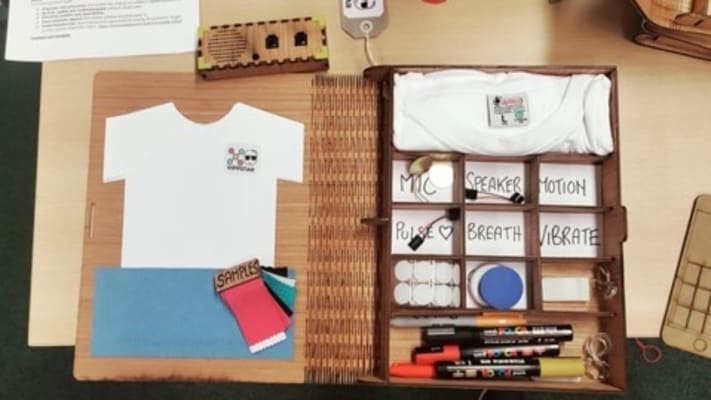
The smart T-shirt, developed with Comftech, explores how sensing and feedback could support physical activity and body awareness. We asked where, when and how a young person with visual impairment might want to wear a sensing T-shirt, what they would use it for, and where they would place the sensors and feedback components. Designing a physical garment with visually impaired adolescents is challenging, because design is predominantly visual. We therefore explored tactile and audio-based tools that let participants build their ideas for a garment while describing how they might use it. We first piloted these tools with design students at the University of Limerick (Fig. 3). We then used refined co-design kits (Fig. 4) with groups of adolescents at summer camps in Italy (Fig. 5) to support their design explorations.
Making room for different contributions
Across the three strands, co-design has also changed how we invite people to take part. An interview or a drawing activity will not suit everyone, and families have little spare time.
We now work with communities where young people and families already gather, and offer tools such as the VIPPSTAR co-design kits that participants can explore with their families at home.
Next, prototypes of all three tools will be tested with young people and families, many of whom helped shape them. Continuing to involve them will show which ideas are useful, which need to change and how the tools can better fit the lives they are meant to support.